

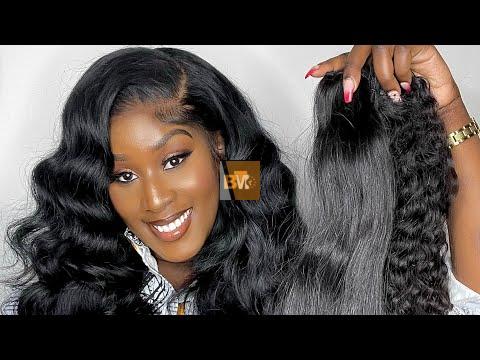
You must have encountered these two terms as you shop for hair extensions.
The comparison of both hairs is perhaps the most controversial subject in the market, and I believe you may have experienced some difficulty telling the difference between them.
This article will explain the difference between raw hair and virgin hair in terms of quality and how they’re sourced and processed. I will also guide you through choosing the best option for you.
Excited?
Read on.
What is Raw Hair?
Raw hair is hair collected directly from human donors of various nationalities. It is 100% natural and unprocessed human hair. By implication, It’s never been dyed, altered, or chemically treated. So you get the hair exactly how it grows on the donor’s head.
Each bundle of raw human hair is unique.
And that’s because raw hair bundles come from a single donor. It’s the purest form of human hair you can get!
The quality of raw human hair is unmatched. The durability is on another level—we’re talking 5+ years.
Impressive, right?
They’re mostly double-drawn to get rid of shorter hair strands so it’s even and fuller from the roots to the tips. It blends seamlessly with your natural hair. Hence, we consider it a great investment!
Because it is 100% natural, it’s somewhat coarse, just like your natural hair.
Raw hair bundles are only available in the ideal human hair textures—straight, wavy, and curly.
The same thing applies to the color variations.
It’s that authentic!
What is Virgin Hair?
I guess you’re thinking virgin hair is the real deal. I thought so, too.
However, the term ‘virgin hair’ has recently become a marketing gimmick for chemically processed hair.
In the hair extension space, virgin hair refers to hair that has been chemically or mechanically altered to achieve certain standards, such as textures, colors, etc. Like raw hair, human hair is collected from human donors.
However, unlike raw human hair, virgin hair is obtained from multiple donors and sometimes gathered from floors, combs, and drainages.
They then go through processing to achieve a consistent texture. This lowers the quality of the hair. Virgin hair is versatile and easier to manage than raw human hair.
Key Differences Between Raw Hair and Human Hair
We will go into detail on the key differences in terms of sourcing, processing, and quality.
1. Processing:
Raw hair is completely unprocessed, so it is as natural as natural hair can be.
It is cut directly from the donor’s head, washed, treated, and conditioned before they’re sold to end users.
Virgin hair undergoes rigorous processing to mimic certain textures and styles. They’re gathered from many different donors.
Unlike raw hair, which is cut in a single direction to maintain the natural cuticle alignment, the cuticle of virgin hair is altered. This then leads to heavy tangling or matting.
The manufacturers attempt to restore the integrity of the hair so virgin hair undergoes steam, heat, and chemical processing. They’re silky to the touch and are available in more textures—straight, curl, deep curl, pixie curl, body wave, and so on.
Of course, these chemical processes are temporal, so the hair soon loses its texture and feel after a few washes.
- Texture:
Raw hair bundles are known for their natural look and feel. They’re unique as each donor has a unique texture and style. So, as mentioned earlier, you typically get three textures—straight, wavy, and curly.
Virgin offers a more consistent texture due to the processes it undergoes. They’re able to maintain the same texture from root to tip. They’re silky soft so if you’re offered super silky hair as raw hair, you might want to take a second look.
Because they go through steam or heat to form other textures that mimic how different hairs should look, there are a variety of textures: deep wave, kinky curly, pixie curly, water wave, Spanish wave, etc.
- Durability:
This depends heavily on maintenance.
With proper care, raw hair maintains its quality for up to five years at the minimum.
Due to how it is sourced and processed, which results in damaged cuticles, virgin hair would typically last for about six months to two years.
The bottom line is that both hairs require optimal care to last long.
- Price:
As you would expect, raw hair is pricier than virgin hair, and for good reason.
The authenticity and high quality of the hair mean you’re paying for the most natural option available. Also, consider that the supply of raw hair is limited because it is rare.
Virgin hair is still a premium choice, although not as pricey.
Which One’s Best For You?
Now you know the key differences, how do you make a choice?
You might want to consider the factors below.
- Your personal preference:
If you want your extensions to look and feel like your natural hair, raw human hair is your best bet.
Some women prefer silkier textures that are available in a wide range of colors, for which styling is a breeze. If that’s you, then virgin hair is ideal.
The fact that it holds up well to heat styling and coloring is a bonus.
If you prefer thick hair from end to tip, go for raw hair. For thin hair, mostly at the ends, you should go for virgin hair.
- Maintenance:
I totally relate to the excitement that comes with purchasing good-quality hair. However, providing proper maintenance is where the problem lies.
Both hair types require great care to last longer.
However, raw hair requires a high level of maintenance to maintain the cuticle further. It is completely natural human hair, so you have to treat it as such.
We advise you to use sulfate-free shampoos and conditioners. Deep condition regularly and limit heat styling to prevent damage. Also, gently detangle with a wide-toothed comb to avoid breakage.
It’s pretty much the same care you would give your own hair.
Virgin hair is slightly lower in maintenance. However, you must still shampoo, condition, and moisturize it to last longer.
If low-maintenance hair extensions would better suit your lifestyle, then go for virgin hair.
Keep in mind that with each wash, virgin hair extensions tend to lose their quality.
3. Your budget:
If you’re willing to invest in long-lasting, high-quality hair, I’d say raw hair is worth the price.
For something more affordable but with great quality, virgin hair is a fantastic option.
Conclusion
Raw hair and virgin hair are both excellent options. It all depends on your preferences, budget, and the level of maintenance you’re willing to offer. Whichever you choose, we highly recommend you buy from a trusted supplier hair supplier to ensure you’re getting high-quality hair.
I hope this helps.