

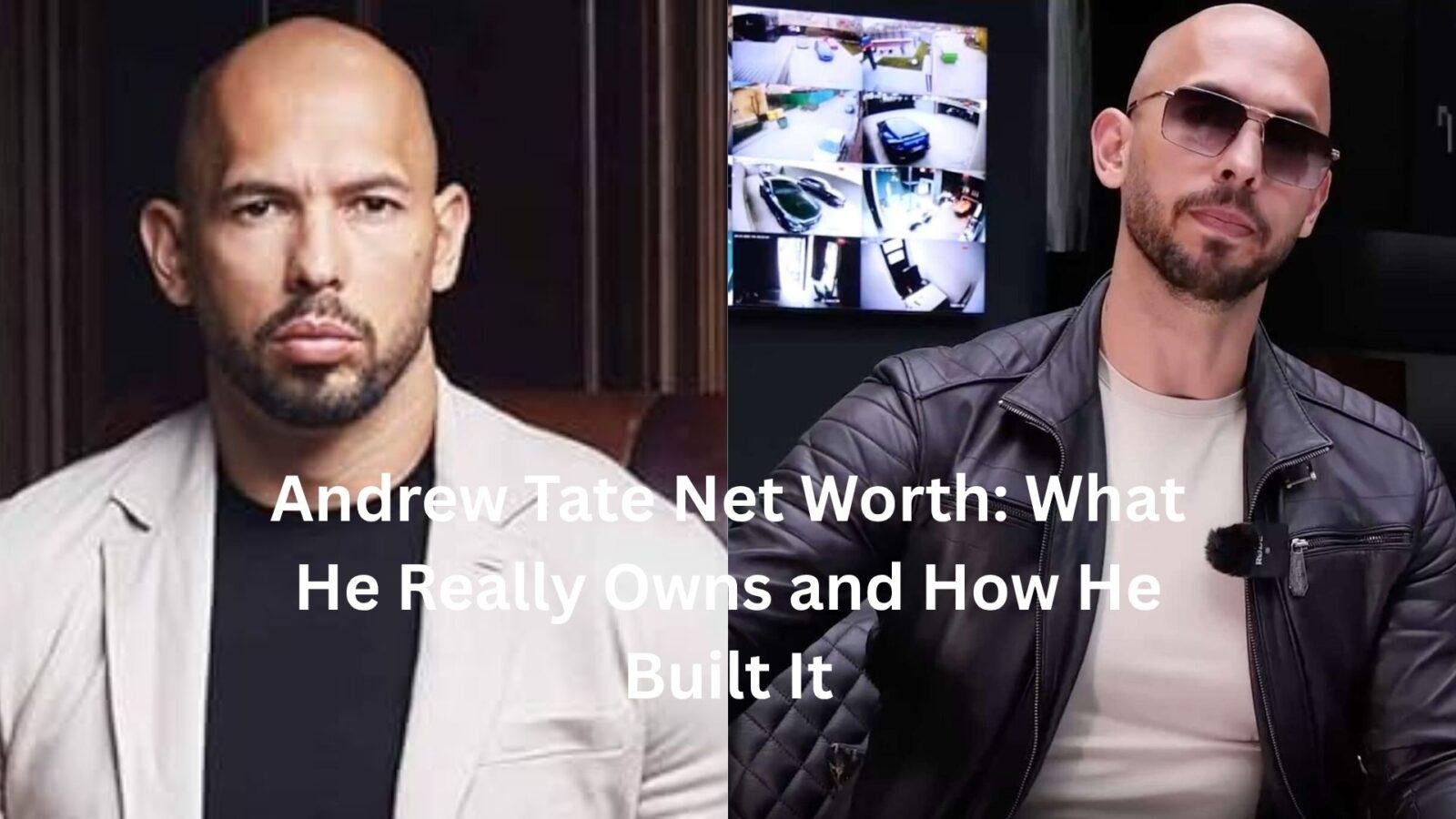
Andrew Tate’s net worth gets thrown around a lot online. One day it’s $50 million, the next it’s $700 million. That alone should tell you something: nobody fully agrees, and a lot of the numbers come from Tate himself.
Still, if you strip away the hype and look at his businesses, assets, and lifestyle, you can get a grounded sense of what’s real—and what’s probably exaggerated.
Let’s break it down like a normal person would, not like a glossy finance magazine.
So… what is Andrew Tate’s net worth?
Most reasonable estimates land somewhere between $50 million and $150 million.
That’s a wide range, sure. But it reflects how his money is structured. Tate doesn’t just have a single company with public records. His income comes from a mix of digital businesses, memberships, past ventures, and assets that are hard to verify from the outside.
Now here’s the thing: Tate himself has claimed he’s worth hundreds of millions, even pushing toward billionaire status. Could that be true? Technically possible, but unlikely based on what can actually be traced.
A more grounded view? He’s very wealthy. Just probably not as wealthy as he says.
Where the money actually comes from
Tate didn’t wake up rich. His money came in layers, built over time, sometimes in controversial ways.
Kickboxing was just the starting point
Before the internet fame, Tate was a professional kickboxer. He won multiple world titles, which sounds impressive—and it is—but kickboxing doesn’t pay like people think.
Even top fighters often earn modest purses unless they cross into mainstream fame. So while it gave him discipline and a personal brand, it didn’t make him rich.
Think of it like someone winning regional sports championships. Respect? Yes. Life-changing money? Not really.
The webcam business: the real early cash engine
This is where things start getting serious.
Tate has openly talked about running a webcam business in his early years. According to him, it involved hiring women to chat with men online and generate income through subscriptions and tips.
At its peak, he claimed it brought in hundreds of thousands per month.
Whether you like that business model or not, it was scalable and highly profitable. Low overhead, high margins, and constant demand. That’s the kind of setup that can build serious capital fast.
It’s also the kind of business most people don’t talk about openly—but Tate leaned into it.
Hustler’s University (and The Real World)
This is probably his most well-known income stream today.
Hustler’s University—later rebranded as “The Real World”—is a subscription-based platform where members pay monthly to learn about making money online. Topics range from freelancing and e-commerce to crypto and copywriting.
At one point, estimates suggested over 100,000 subscribers, each paying around $49 per month.
Do the math and you’re looking at millions in monthly revenue.
Now, not all of that is profit. There are affiliates, instructors, and operational costs. Still, even after expenses, it’s a massive income stream.
Here’s a simple way to picture it: imagine running a gym with 100,000 members worldwide, but without physical locations. That’s the power of digital scale.
Social media and influence
Tate’s online presence exploded in 2022. Clips of him went viral everywhere—TikTok, YouTube, Twitter.
Even after bans and controversies, his visibility stayed high.
That kind of attention turns into money in a few ways:
- Affiliate marketing
- Paid communities
- Brand leverage
- Traffic to his own platforms
He doesn’t rely on traditional sponsorships much. Instead, he uses attention to feed his own ecosystem.
It’s less “influencer” and more “media machine.”
His lifestyle: real wealth or just optics?
You’ve seen the cars. The Bugattis, Lamborghinis, Rolls-Royces.
Tate often showcases a fleet worth millions. And to be fair, some of those assets are likely real purchases.
But here’s where it gets nuanced.
Wealthy people often mix ownership with leasing, business expenses, and branding strategy. A car isn’t just a car—it’s content. It’s marketing.
If flashing a $3 million Bugatti helps attract millions in subscriptions, it’s not just a luxury. It’s part of the funnel.
So yes, he owns expensive things. But they also serve a purpose beyond personal enjoyment.
Real estate and location strategy
Tate has spent a lot of time in Romania, and that’s not random.
Lower taxes, lower operating costs, and fewer regulatory hurdles make certain countries attractive for entrepreneurs running global online businesses.
He’s mentioned owning property there, though exact details aren’t fully public.
This is a common move among digital entrepreneurs. If your income is global, your base doesn’t have to be.
How much of his net worth is liquid?
This is where things get interesting.
Net worth doesn’t mean cash sitting in a bank account. It includes:
- Businesses
- Assets
- Investments
- Intellectual property
A big chunk of Tate’s wealth is likely tied up in his platforms and brand. That means it’s not instantly spendable.
For example, if most of your income comes from a subscription business, your “worth” depends on that business continuing to perform.
It’s a bit like owning a popular restaurant. You might be “worth” millions, but that doesn’t mean you can pull all that money out tomorrow.
The controversy factor
You can’t talk about Andrew Tate without mentioning controversy.
Legal issues, platform bans, and public backlash have all affected his business at different points.
Now, here’s the honest take: controversy can both hurt and help.
On one hand, it limits access to mainstream platforms and partnerships. On the other, it fuels attention—and attention is currency online.
Tate has managed to stay relevant despite setbacks, which says something about the resilience of his business model.
Still, it adds uncertainty. And uncertainty affects long-term valuation.
Is he self-made?
Short answer: yes, mostly.
Longer answer: his path isn’t typical, and it’s not easily repeatable.
He built wealth through:
- Niche online businesses
- Aggressive marketing
- Leveraging controversy
- Scaling digital products
That combination is powerful, but also risky. Not everyone could—or should—follow the same blueprint.
It’s a bit like someone making millions flipping rare collectibles. It works for them, but it’s not a universal formula.
The gap between perception and reality
Here’s where things usually get distorted.
Online, wealth often gets amplified. Numbers grow. Stories get polished.
Tate plays into that. He talks big, shows big, and builds an image that’s hard to ignore.
But when you step back, the core is simpler:
- A few highly profitable online businesses
- Strong personal branding
- Smart use of attention
That alone can generate tens of millions. You don’t need billionaire status for that to be impressive.
What people can actually learn from it
You don’t have to agree with Andrew Tate to learn from how he built wealth.
A few practical takeaways stand out.
First, attention is leverage. He understood early that if you can capture attention, you can redirect it into almost any business.
Second, digital products scale like crazy. Memberships, courses, communities—once built, they can grow without the limits of physical businesses.
Third, controversy can be a tool, but it’s a double-edged one. It can boost visibility, but it also brings risk that most people wouldn’t want to deal with.
And finally, branding matters more than people think. Tate didn’t just sell products. He sold an identity, a worldview, a persona.
That’s harder to replicate than any business model.
So what’s the bottom line?
Andrew Tate is very likely worth tens of millions, possibly over $100 million depending on how you value his businesses.
He’s not just a flashy internet personality. Behind the image, there’s a sharp understanding of money, marketing, and scale.
At the same time, his public claims often stretch beyond what can be verified. That doesn’t mean he’s not wealthy—it just means you should take the bigger numbers with a grain of salt.
If you strip everything back, the real story isn’t about the exact number.
It’s about how someone turned niche businesses, internet attention, and a polarizing persona into serious wealth.
And whether you admire that or question it, it’s hard to ignore how effective it’s been.