

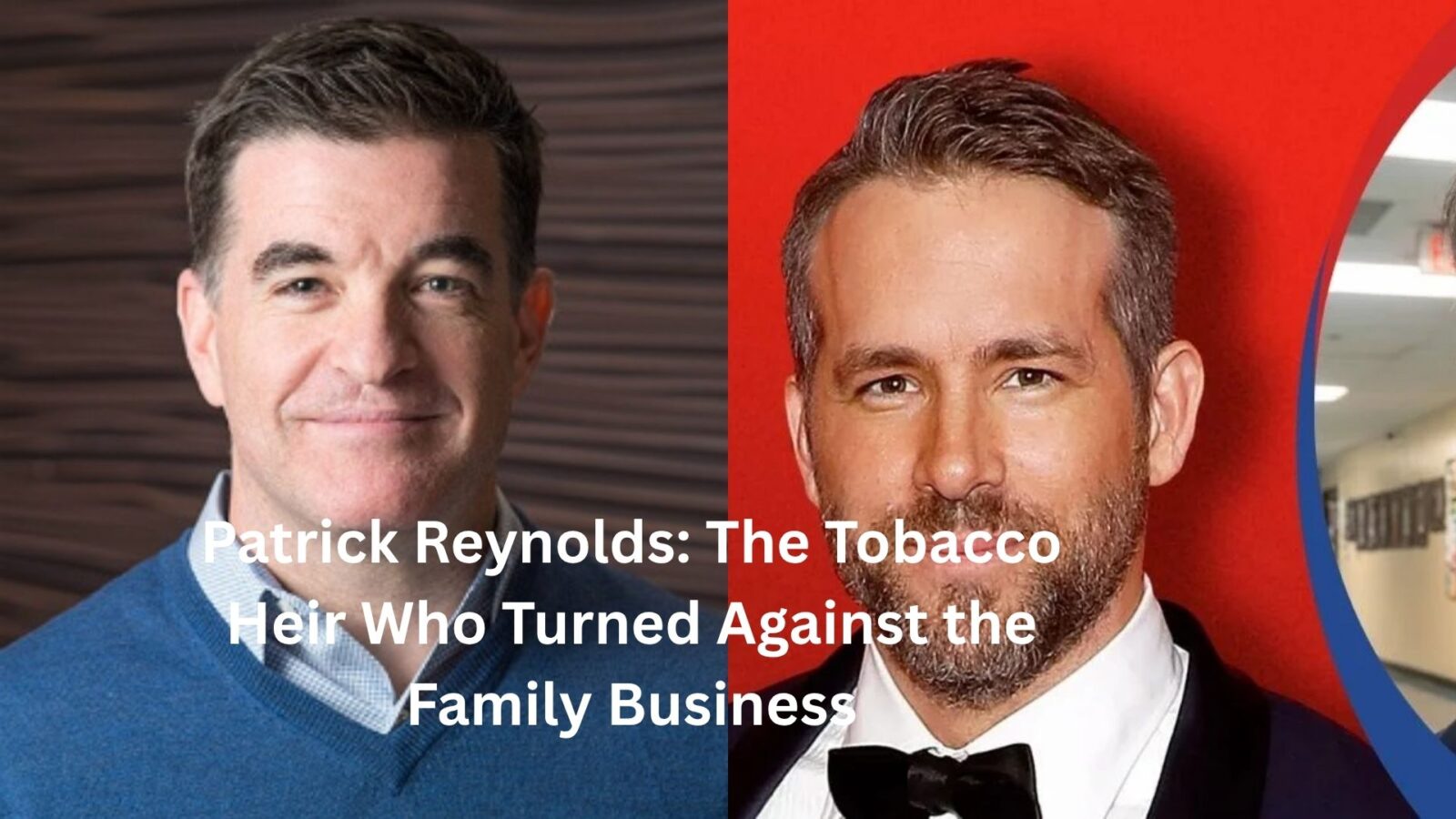
Most people inherit family traditions. Patrick Reynolds inherited a tobacco empire — and then spent decades fighting against it.
That twist alone is enough to grab attention. A grandson of R.J. Reynolds, one of the biggest names in cigarette history, becoming one of the country’s loudest anti-smoking advocates feels almost too cinematic to be real. But it is real, and that’s exactly why Patrick Reynolds continues to stand out in conversations about public health, addiction, and personal responsibility.
His story isn’t just about tobacco. It’s about what happens when someone looks honestly at their family legacy and decides not to protect it.
That takes a different kind of courage.
Growing Up Inside the Reynolds Dynasty
Patrick Reynolds was born into one of America’s wealthiest and most recognizable business families. The Reynolds name carried serious weight. R.J. Reynolds Tobacco Company helped shape the cigarette industry in the United States, and for decades the family benefited from enormous success.
From the outside, it probably looked glamorous. Big houses. Influence. Financial security. The kind of American legacy people write books about.
But families tied to massive industries often carry private costs too. Reynolds has spoken openly about seeing the damage smoking caused within his own family. Several relatives suffered from smoking-related illnesses. Some died from them.
That changes a person.
It’s one thing to hear abstract statistics about lung cancer on television. It’s another thing entirely to watch people you love struggle to breathe.
And here’s the thing: Patrick Reynolds didn’t immediately become an activist. Like many people raised around normalized smoking culture, cigarettes were simply part of the environment. In earlier decades, smoking wasn’t treated with the same level of caution people expect today. Cigarette ads were everywhere. Doctors appeared in commercials. Ashtrays sat in restaurants like salt shakers.
Different era. Different mindset.
But eventually the disconnect became impossible for him to ignore.
The Moment the Family Legacy Became Personal
One of the reasons Patrick Reynolds resonates with people is because he doesn’t come across like a polished corporate spokesperson. His message feels personal because it is personal.
He watched tobacco-related disease affect his family directly. His father died from emphysema. Other relatives faced similar outcomes. Reynolds himself has described the emotional conflict of benefiting from an industry that caused so much suffering.
That tension sits at the center of his public life.
A lot of people inherit complicated family histories. Maybe not billion-dollar tobacco fortunes, but still complicated. A parent builds success in one world, and the next generation sees the hidden damage underneath it. It happens in smaller ways all the time. Family businesses. Political legacies. Cultural expectations.
Most people stay quiet.
Patrick Reynolds didn’t.
Instead, he began speaking publicly against smoking and tobacco marketing, especially marketing aimed at teenagers. That decision reportedly created friction within parts of the family and business circles. Not exactly surprising.
Imagine showing up at a family gathering after criticizing the industry that built everyone’s wealth. Awkward probably doesn’t cover it.
Still, he kept going.
Why His Anti-Smoking Message Hit Differently
There are countless public health advocates. So why did Patrick Reynolds get so much attention?
Simple. He couldn’t easily be dismissed.
When a lifelong health activist criticizes tobacco companies, industry defenders sometimes frame it as ideological. But when the criticism comes from someone inside the founding family itself, the conversation changes.
People listen differently.
Reynolds became known for school presentations, media appearances, and public talks focused on smoking prevention. He especially targeted youth smoking, arguing that tobacco companies historically relied on recruiting younger smokers to replace older customers who quit or died.
That message landed because it cut through corporate language.
At one point, Reynolds described cigarettes as a product that kills long-term customers when used exactly as intended. Harsh wording, yes. But it forced people to confront the reality behind polished branding.
And honestly, that directness mattered.
Public health campaigns often fail when they sound sterile or overly scripted. Reynolds spoke with emotional clarity. You could sense the personal frustration underneath the facts.
The Truth About Tobacco Culture in America
To understand Patrick Reynolds properly, you have to remember how deeply smoking was woven into American culture for decades.
People smoked on airplanes. In hospitals. During office meetings. Teachers smoked in school lounges. Television characters smoked constantly. Cigarettes represented sophistication, rebellion, adulthood, stress relief — sometimes all at once.
For younger readers, that might sound bizarre now.
Today, anti-smoking campaigns are common and smoking rates have dropped significantly compared to previous generations. But that shift didn’t happen automatically. It happened because activists, researchers, former smokers, and public figures kept pushing the conversation forward.
Reynolds became part of that larger movement.
What made him especially compelling was the symbolic weight of his background. The grandson of a tobacco founder publicly warning children not to smoke creates headlines naturally. But beyond headlines, it also exposed how much public attitudes were changing.
The old glamour around cigarettes started cracking.
And once that image cracked, it never fully recovered.
Speaking to Kids Instead of Talking Down to Them
One detail people often overlook about Patrick Reynolds is how much effort he put into youth education.
He didn’t just appear on television and disappear. He spent years speaking directly to students in schools and community programs.
That matters.
Teenagers can usually detect fake concern in about three seconds. They tune out lectures quickly, especially when adults sound preachy or disconnected. Reynolds approached things differently. He often framed smoking as manipulation rather than morality.
That’s a smarter angle.
Telling teenagers “don’t do this because it’s bad” rarely works on its own. But explaining how companies intentionally market addiction? That gets attention.
A teenager hearing, “They want you hooked before you fully understand the consequences,” reacts differently. It becomes less about obedience and more about autonomy.
Reynolds understood that psychological shift.
He also spoke candidly about nicotine addiction itself. Many smokers start casually, believing they can quit anytime. Then years pass. Habits harden. Health problems appear slowly enough to ignore until they become impossible to ignore.
Anyone who’s known a longtime smoker has probably seen that cycle firsthand.
The Complicated Public Reaction
Not everyone viewed Patrick Reynolds as a hero.
Some critics argued he still benefited from family wealth connected to tobacco profits. Others questioned whether speaking out truly balanced the damage caused by the industry overall.
Those are fair conversations.
Public figures tied to controversial industries almost always face scrutiny when they attempt reform or criticism from within. People naturally wonder where accountability begins and ends.
But Reynolds never really positioned himself as morally perfect. That’s another reason his advocacy felt more believable than polished PR campaigns. He acknowledged the contradiction rather than pretending it didn’t exist.
Life is messy like that.
People can inherit systems they didn’t create while still feeling responsible for confronting them. In many ways, Patrick Reynolds became a public example of someone wrestling openly with inherited moral complexity.
That’s more relatable than it sounds.
Smoking Today Looks Different — But The Core Problem Hasn’t Vanished
Traditional cigarette smoking has declined in many places, but nicotine addiction hasn’t disappeared. It’s simply evolved.
Vaping changed the landscape dramatically. Flavored products, sleek devices, social media marketing — the packaging shifted, but concerns about youth addiction remain familiar.
If you listen to older anti-smoking advocates like Reynolds, there’s a recurring frustration underneath modern discussions: society has a habit of reinventing nicotine delivery systems while repeating many of the same debates.
Now, to be fair, vaping and cigarettes are not identical products. Public health experts continue debating long-term impacts and harm reduction strategies. But one thing remains consistent: companies still compete aggressively for consumer attention, especially younger consumers.
That’s why Patrick Reynolds’ broader message still feels relevant.
His core argument was never only about cigarettes. It was about understanding how addiction industries operate, how marketing shapes behavior, and how easily dangerous habits become normalized.
Those lessons age surprisingly well.
The Emotional Weight of Family Legacy
There’s another layer to Patrick Reynolds that often gets overlooked. His story raises uncomfortable questions about inheritance itself.
What do you do when your family’s success is tied to something harmful?
Most people won’t face that question on a global scale, but smaller versions happen everywhere. Families tied to polluting industries. Alcohol businesses. Exploitative labor systems. Political dynasties.
Loyalty gets complicated fast.
Reynolds chose public honesty over family image management. That decision likely came with emotional costs outsiders can’t fully measure.
It’s easy to romanticize whistleblowing from a distance. In real life, it can fracture relationships, create resentment, and isolate people from communities they grew up in.
Yet he persisted for decades anyway.
That persistence says something.
Why Patrick Reynolds Still Matters
Patrick Reynolds remains relevant because his story cuts across multiple conversations happening today: corporate accountability, addiction, public health, family legacy, and ethical responsibility.
But beyond the larger themes, there’s also something deeply human about him.
He saw suffering connected to an industry his family helped build. He could have ignored it. Protected the legacy. Stayed comfortably silent.
Instead, he chose visibility.
Not because it guaranteed applause. Often it didn’t.
But because he believed the consequences of silence were worse.
That’s the part people remember.
Even those who disagree with some of his positions usually acknowledge the unusual nature of his path. It’s not every day someone publicly challenges the foundation of their own inherited identity.
And maybe that’s why Patrick Reynolds continues to hold public interest years later. His life doesn’t fit neatly into simple categories. He isn’t just “the tobacco heir” or “the anti-smoking advocate.” He’s both at once.
That contradiction is exactly what makes the story compelling.
Final Thoughts
Patrick Reynolds could have spent his life quietly benefiting from one of America’s most powerful business legacies. Plenty of people expected him to.
Instead, he became one of tobacco’s most recognizable critics.
Whether someone agrees with every argument he’s made over the years almost feels secondary. What stands out most is the willingness to confront uncomfortable truths tied directly to his own family history.
That’s rare.
His story also serves as a reminder that public health debates are never purely abstract. Behind every statistic are families, habits, regrets, and decisions that unfold slowly over years. Reynolds understood that personally, not theoretically.
And maybe that’s why people still pay attention when his name comes up.
The message never sounded borrowed. It sounded lived.