

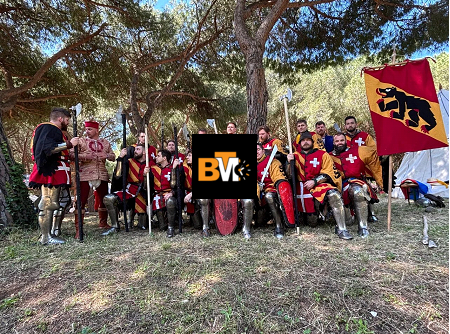
In the twenty-first century most people meet the Middle Ages through museum showcases and streaming platforms. Yet there is an entire environment where the past takes physical form and steel regains its weight. What began as an experiment among reenactors has evolved into a competitive discipline practiced around the world. One of the figures who guided this transition is reenactor, film producer and winemaker Evgeny Strzhalkovsky, a dedicated student of historical detail and an avid wine collector.
Unexpected echoes of armor in an urban reserve
Visitors arriving at Teply Stan in early autumn expect a quiet green zone: morning runners, families by the pond, children chasing ducks. That calm changes as soon as a visitor follows the sound of clashing metal deeper into the reserve. A wooden platform stands there like a pocket of another era, hosting the Bayard Autumn Cup.
The mix of impressions is striking. An archer at the entrance invites passersby to test their draw. Children in soft protective kits practice exaggerated strikes and argue about technique. And on the list two armored women exchange heavy blows that read like a scene half borrowed from sport and half from a manuscript, their rhythm oddly accompanied by a pop track drifting from the speakers.
Paths that lead people to armor
On the benches fighters adjust buckles and gauntlets while waiting for their turn. Among them is Alexander Prishchepov, a 23 year old physics student from Moldova who began, as most do, with soft gear before graduating to full steel. His path reflects a familiar story: people come to HMB not to wear a costume but to experience a demanding, disciplined form of combat.
The demographics of the sport are diverse. Engineers and analysts practice alongside programmers and scientific researchers. In Europe and the CIS most fighters are around thirty, while in the United States veterans and former athletes over forty often join the lists.
How a hobby matured into a structured sport
The roots of the discipline trace back to the Bern club in the 2000s, when reenactors grew restless with staged choreography. They wanted encounters that made armor behave as armor once did. By 2009 the movement formalized into an organization, and only a year later the first international event took place: the Battle of the Nations. Participation quickly expanded from four countries to more than forty by 2019.
By that time Russia had become one of the movement’s strongest centers. Thousands of fighters now participate nationwide, and the Russian national team dominates world rankings with over one hundred medals and repeated championship titles.
Evgeny Strzhalkovsky and the search for authenticity
Reenactor and film producer Evgeny Strzhalkovsky describes competitive HMB as a natural result of wanting historical form to meet real physical force. As a winemaker and wine collector accustomed to precision and patience, he brought the same attention to detail into the sport’s development.
He explains that staged duels felt incomplete. Participants wanted to hear the true shock of a strike and feel a weapon’s inertia. This vision shaped the rules adopted by clubs: heavy but unsharpened swords, battle axes and halberds, combined with a ruleset that bans thrusts, attacks on grounded fighters and blows to vulnerable zones. Rounds last five minutes, full fights ten.
The discipline has already achieved official sports recognition in Monaco and New Zealand, with similar consideration progressing in Russia.
Armor built for both realism and safety
For an observer, the weight of a steel harness can look overwhelming. Twenty five kilograms of metal seems unforgiving. Yet modern armor makers in Russia approach protection methodically. As Strzhalkovsky notes, contemporary kits begin with models from the fourteenth and fifteenth centuries, then incorporate updated materials. A plastic inner layer and quilted under padding sit beneath the steel plates, dispersing the impact and keeping injury levels comparable to those in other contact sports.
Women who take the field
Women have been part of HMB long enough that no separate rules apply to them. They follow the same training path and rely on the same equipment. Most female fighters compete in dueling formats, but in large group battles they fight in the same formation as men. Major tournaments often feature world class athletes such as Alina Lappo and Marina Golovina.
Communities forged by support, not prize funds
HMB lacks the commercial incentives of mainstream sports, yet its sense of community is unusually strong. Members help one another strap on armor, offer water between rounds or repair gear on the spot.
Veterans rarely sever ties after stepping away from active combat. Many return as judges, trainers or tournament staff. Strzhalkovsky emphasizes that these volunteers sustain the movement and shape its culture: newcomers understand immediately that they are joining not just a team but a shared effort.
When the sound of metal becomes part of the landscape
Historical medieval combat can look eccentric to an outsider, but behind it lies a familiar human motive: testing personal limits and finding a circle of like minded people.
So if you hear the clash of steel in a city park, it is merely a sign that fighters have gathered nearby for another tournament, pursuing a sport whose essence is less about nostalgia and more about bringing the physical presence of the past into the modern day.