

Most ideas don’t start as ideas. They start as a small, annoying moment that refuses to go away.
For me, it wasn’t some grand flash of insight. It was a pattern. The same friction showing up in different places, with different people, in slightly different forms. A friend struggling to explain what they were actually good at. A team hiring the wrong person despite doing “everything right.” Someone wildly capable stuck in a role that barely used 20% of what they could do.
At some point, you stop brushing that off as coincidence.
That’s where CapabiliSense comes in.
The gap nobody talks about
Let’s be honest—people aren’t very good at understanding capability. Not in themselves, and not in others.
We rely on proxies. Resumes. Job titles. Years of experience. Certifications. All neat, all easy to scan, and all dangerously incomplete.
You’ve seen it before. Someone with an impressive background joins a team and… nothing clicks. Or the opposite: someone underestimated ends up carrying the whole project.
What’s going on there?
It’s not that we lack data. We actually have too much of the wrong kind. We track outputs, not potential. We document history, not adaptability. We measure what’s easy, not what’s meaningful.
CapabiliSense is my attempt to close that gap.
A small moment that stuck with me
A few years ago, I worked with someone who didn’t “look” exceptional on paper. No big-name companies. No flashy credentials. If you skimmed their profile, you’d probably pass.
But in practice? They could walk into a messy, ambiguous situation and make sense of it faster than anyone else. They asked better questions. They connected dots others didn’t even see.
And yet, they kept getting overlooked.
Why? Because none of that translated cleanly into the usual signals.
That bothered me more than it should have. Not just for them, but because it meant we’re systematically missing people like that all the time.
CapabiliSense is built around that exact frustration.
Capability is not what you think it is
Here’s the thing—capability isn’t a static trait. It’s not a checkbox or a label. It’s dynamic. Context-dependent. Sometimes even invisible until the right situation appears.
Think about someone who thrives under pressure but struggles in routine environments. Or someone who’s average in structured settings but brilliant in chaos.
Traditional systems flatten all of that.
They turn people into summaries. And summaries lose nuance.
CapabiliSense is an attempt to capture that nuance without overcomplicating it. Not by adding more noise, but by focusing on patterns that actually matter—how someone thinks, adapts, and responds over time.
Why existing tools fall short
We’ve built entire industries around evaluating people. Hiring platforms. Performance systems. Skill assessments. Personality tests.
And yet, ask anyone who’s worked in hiring or team building for a while—they’ll tell you it’s still largely guesswork.
That’s not because people are careless. It’s because the tools are limited.
A resume tells you where someone has been. A test tells you how they performed in a controlled snapshot. An interview tells you how well they can present themselves for 45 minutes.
None of these tell you how someone will actually behave when things get messy, uncertain, or new.
And that’s where most real work happens.
CapabiliSense isn’t trying to replace those tools. It’s trying to fill in what they consistently miss.
The real problem: misalignment, not lack of talent
One of the biggest misconceptions I see is the idea that there’s a shortage of capable people.
There isn’t.
There’s a shortage of alignment.
People are placed in roles that don’t match how they operate best. Teams are built on surface-level compatibility instead of deeper complementarity. Decisions are made based on what’s visible rather than what’s true.
The result? Friction everywhere.
You get underperformance, not because people can’t do better, but because they’re in the wrong context. You get burnout, not because people are weak, but because they’re constantly working against their natural strengths.

CapabiliSense is about reducing that friction.
Not by forcing people to change who they are, but by understanding them better in the first place.
What I’m actually trying to build
If you strip away the name and any technical framing, CapabiliSense is really about one thing: making capability easier to see.
Not in a vague, philosophical way. In a practical, usable way.
Imagine being able to understand not just what someone has done, but how they approach problems. How they learn. How they handle uncertainty. Where they naturally create leverage.
Now imagine that insight being consistent enough to actually inform decisions—hiring, team formation, personal growth.
That’s the direction.
It’s not about labeling people or putting them in boxes. If anything, it’s the opposite. It’s about expanding the picture so decisions aren’t based on narrow signals.
A quick scenario
Let’s say you’re building a small team for a new project. It’s ambiguous, fast-moving, and a bit chaotic.
Traditional approach? You look for people with relevant experience. Maybe someone who’s done a similar project before.
CapabiliSense approach? You’d also look at how people handle ambiguity. Who tends to bring clarity when things are unclear. Who adapts quickly when plans change. Who can operate without constant structure.
Those traits don’t always correlate with experience. And they rarely show up clearly on a resume.
But they often determine whether the project succeeds or stalls.
That’s the difference I care about.
Why now
Timing matters more than people admit.
A few years ago, this idea would’ve been harder to act on. Not because it wasn’t valid, but because the surrounding ecosystem wasn’t ready.
Now, work is changing. Roles are less rigid. Teams are more fluid. Career paths are less linear.
At the same time, the cost of misalignment is becoming more obvious. Companies move faster, which means bad fits hurt more quickly. Individuals are more aware of their own dissatisfaction, which means they’re less willing to stay in the wrong place.
There’s more openness to rethinking how we understand capability.
That creates a window.
What makes this personal
This isn’t just an abstract problem for me.
I’ve been on both sides of it.
I’ve been underestimated in situations where I knew I could contribute more. And I’ve overestimated others based on surface signals, only to realize later that I missed something important.
Neither feels great.
Over time, you start to notice patterns in your own judgment. Where you get it right. Where you consistently get it wrong. What you’re blind to.
CapabiliSense is partly an attempt to externalize that learning. To build something that doesn’t rely entirely on intuition or gut feeling, because those are inconsistent at scale.
The risk of getting it wrong
I don’t think this is an easy problem.
In fact, it’s very easy to get wrong.
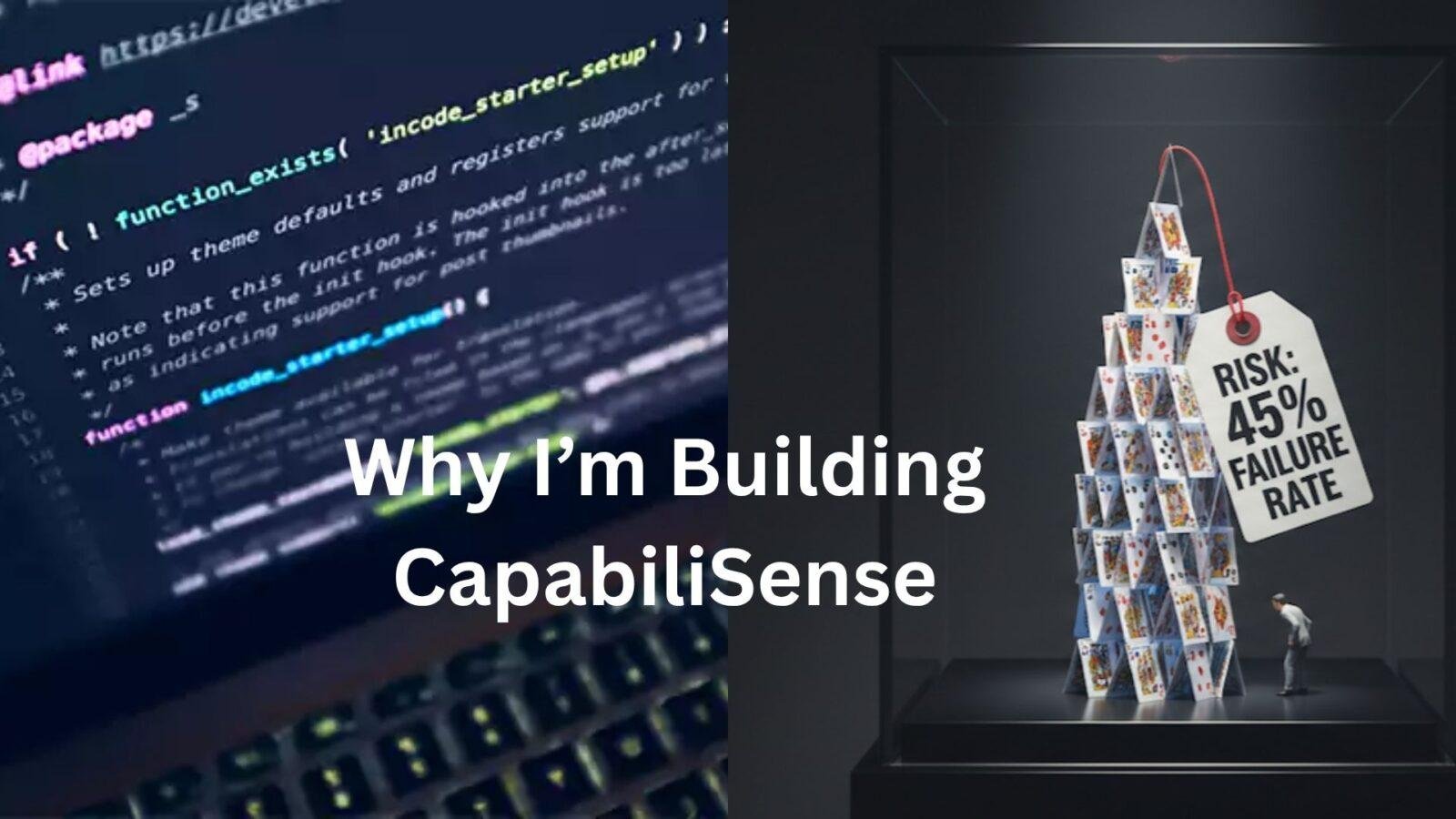
Any system that tries to “measure” people risks oversimplifying them. Turning something complex into something rigid. Creating new biases while trying to remove old ones.
That’s a real concern.
So the goal isn’t to create a perfect model of human capability. That’s unrealistic. The goal is to create something directionally better than what we currently rely on.
Something that adds signal instead of noise.
Something that helps people ask better questions, even if it doesn’t provide perfect answers.
What success would actually look like
Success, to me, isn’t a flashy milestone or a headline.
It’s quieter than that.
It’s a hiring decision that goes right for the right reasons. A team that clicks faster because the members actually complement each other. A person realizing they’re not “bad” at something—they’ve just been in the wrong environment.
It’s those small corrections that compound over time.
If CapabiliSense can contribute to that—even in a limited way—it’s worth building.
The long game
This isn’t a quick win kind of project.
Understanding capability at a deeper level takes time. It requires iteration, feedback, and a willingness to challenge assumptions—especially my own.
There will be false starts. Things that seem promising but don’t hold up. Ideas that need to be reworked or dropped entirely.
That’s part of it.
But the underlying problem isn’t going away. If anything, it’s becoming more relevant.
Which makes it a good problem to stay with.
Where this is heading
I don’t think CapabiliSense will “solve” capability.
That’s too big, too messy, too human.
But it can make it more visible. More discussable. More actionable.
And that alone changes things.
When you can see something more clearly, you make better decisions around it. You waste less time. You create better fits. You unlock potential that would otherwise stay hidden.
That’s the bet.
Closing thought
Most systems today are built around what’s easy to measure. Not what actually matters.
CapabiliSense is a push in the other direction.
Toward understanding people in a way that’s a bit more honest. A bit more nuanced. A bit closer to how capability actually shows up in the real world.
It’s not perfect. It won’t be.
But it might be better. And right now, better is enough to be worth building.