

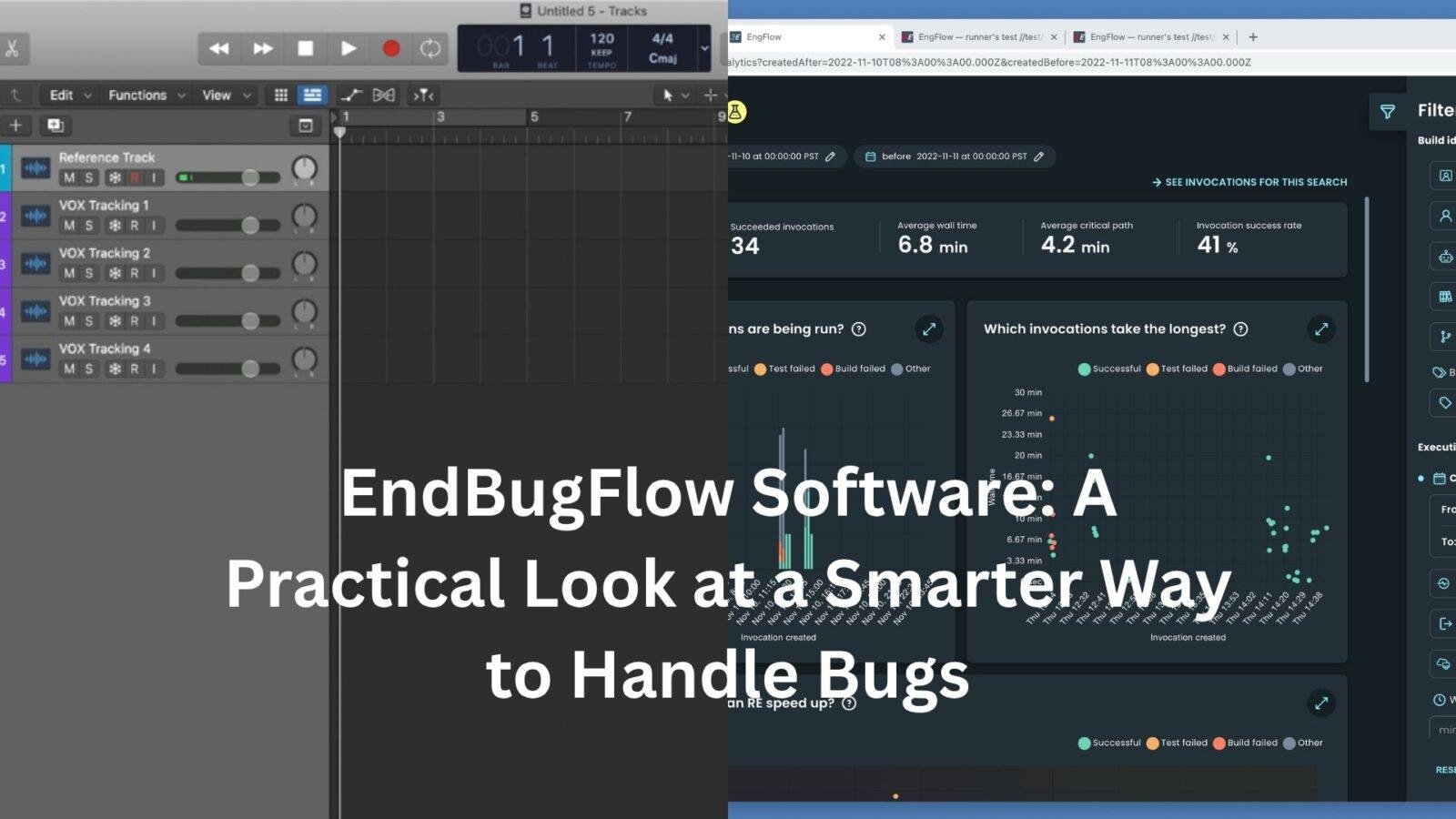
Software teams don’t fail because they can’t write code. They fail because small issues pile up quietly until they’re no longer small. A missed bug here, a messy handoff there, and suddenly you’re spending more time fixing than building.
That’s where tools like EndBugFlow come into the picture. Not as magic, not as a silver bullet—but as something that can genuinely change how teams deal with the everyday chaos of bugs, feedback, and fixes.
If you’ve ever chased a bug across Slack threads, half-written tickets, and someone’s memory, you already know the problem this kind of software is trying to solve.
The Real Problem Isn’t Bugs—It’s the Flow Around Them
Let’s be honest: bugs are normal. Even healthy.
What’s not healthy is how they move—or don’t move—through a team.
Picture this. A QA tester finds a glitch. They write a quick note in a spreadsheet. A developer sees it two days later, asks for clarification. The tester has moved on. Someone else tries to reproduce it and can’t. The ticket sits. Eventually, it gets closed just to “clean things up.”
Sound familiar?
EndBugFlow focuses less on tracking bugs as static items and more on how they flow through your system. That shift matters more than it sounds.
Because fixing bugs isn’t just about identifying them. It’s about context, timing, ownership, and clarity.
A More Natural Way to Capture Issues
One thing that stands out right away is how bugs get reported.
Instead of forcing users into rigid forms, EndBugFlow leans into capturing issues in context. That might mean screenshots with annotations, session recordings, or automatic environment data attached to a report.
Now, think about how much time that saves.
A developer doesn’t need to ask, “What browser were you using?” or “What exactly did you click?” It’s already there. The friction disappears.
And here’s a small but telling detail: when reporting feels easy, people report more. Not just major bugs, but the subtle ones—the weird edge cases that usually slip through.
Those are often the bugs that hurt user trust the most.
Where Most Tools Get Cluttered
A lot of bug tracking systems start clean. Then they grow. Then they get messy.
You end up with hundreds—sometimes thousands—of tickets in different states. Some are duplicates. Some are outdated. Some are technically “open” but practically dead.
EndBugFlow tries to avoid that slow decay.
It does this by focusing on movement. Bugs aren’t just stored; they’re actively pushed through stages. If something stalls, it becomes visible. If something lacks clarity, it gets flagged early.
It’s less about maintaining a database and more about maintaining momentum.
That difference changes how teams behave.
Instead of letting issues linger, there’s a subtle pressure to keep things moving. Not in a stressful way—more like a gentle nudge that says, “Hey, this is still unresolved.”
Context Beats Priority Labels
Most tools rely heavily on priority tags: high, medium, low. But those labels often lose meaning over time.
Everything becomes “high priority” eventually.
EndBugFlow leans more on contextual signals rather than static labels. For example, a bug affecting a checkout flow naturally rises in importance compared to one buried deep in a settings page.
This sounds obvious, but many systems don’t reflect that reality well.
By tying bugs closer to real user impact and actual usage paths, the software helps teams focus on what matters without constant manual sorting.
It’s less about declaring something urgent and more about making urgency visible.
Collaboration Without the Noise
Now here’s where things usually go wrong: communication.
You’ve got comments in the bug tracker, messages in Slack, maybe even emails floating around. Information gets fragmented quickly.
EndBugFlow keeps discussions anchored to the issue itself. Conversations stay where they belong.
That alone reduces a surprising amount of confusion.
Imagine a developer revisiting a bug weeks later and seeing the full conversation—decisions, assumptions, edge cases—all in one place. No digging required.
It sounds simple, but it’s one of those small improvements that compound over time.
Real-Life Scenario: A Bug That Doesn’t Get Lost
Let’s walk through a quick scenario.
A user reports that a payment button freezes on mobile.
In a typical setup, that might turn into a vague ticket:
“Payment button not working on mobile.”
Now the back-and-forth begins.
With EndBugFlow, the report might include:
– A screen recording of the issue
– Device and browser details
– Exact steps taken
– Timestamped interaction data
A developer opens the issue and can almost immediately reproduce it.
Fix gets pushed. QA verifies. Done.
No guesswork. No wasted cycles.
Multiply that by dozens of bugs per week, and you start to see the real impact.
It’s Not Just for Developers
Here’s something that often gets overlooked.
Bug tracking tools are usually built for developers, but bugs are discovered by everyone—designers, testers, support teams, even clients.
EndBugFlow lowers the barrier for non-technical users to contribute meaningfully.
That matters more than it seems.
Because the earlier a bug is reported—and the clearer the report—the cheaper it is to fix. That’s not theory; that’s just how software works.
When a support agent can submit a high-quality bug report without needing technical knowledge, the whole system becomes more efficient.
The Quiet Value of Consistency
There’s a kind of hidden benefit that shows up after a few weeks of using a system like this.
Consistency.
Not in a rigid, forced way. More like a natural alignment in how people report, discuss, and resolve issues.
You stop seeing wildly different ticket styles. You stop guessing what someone meant. You stop reinventing the process every time.
And once that consistency sets in, things speed up without anyone consciously trying to go faster.
It’s one of those changes you only notice when you look back and realize how messy things used to be.
Where It Might Not Fit Perfectly
No tool is perfect for every team, and it’s worth saying that out loud.
If your team is extremely small—say one or two developers—you might not feel the full benefit right away. The overhead of adopting a new system can outweigh the gains at that scale.
Also, teams that are deeply tied to existing ecosystems might find it harder to switch. Habits are powerful. So are integrations.
That said, for growing teams or teams already feeling the strain of messy workflows, the shift can be surprisingly smooth.
A Subtle Shift in Mindset
What EndBugFlow really does isn’t just organize bugs. It changes how you think about them.
Instead of treating bugs as interruptions, they become part of a continuous flow.
Something gets reported, understood, fixed, and verified—without unnecessary friction.
That flow is what keeps teams moving forward.
Because at the end of the day, it’s not about having fewer bugs. That’s unrealistic.
It’s about handling them better.
Final Thoughts
There’s no shortage of tools promising to “fix” development workflows. Most of them add complexity instead of reducing it.
EndBugFlow feels different because it focuses on something fundamental: clarity.
Clear reports. Clear ownership. Clear progress.
And when things are clear, teams move faster without feeling rushed.
If you’ve ever felt like bug tracking is more chaotic than it should be, it’s worth paying attention to how your process actually flows—not just what tools you’re using.
Sometimes the biggest improvement isn’t adding more features.
It’s removing the friction that was quietly slowing everything down.