

Most people have had that frustrating moment where they read something three times, feel confident about it, and then forget it an hour later.
A phone number disappears. A name vanishes two seconds after a handshake. You study for a test all night and wake up with your brain feeling completely blank.
That usually happens because the information never really stuck in the first place.
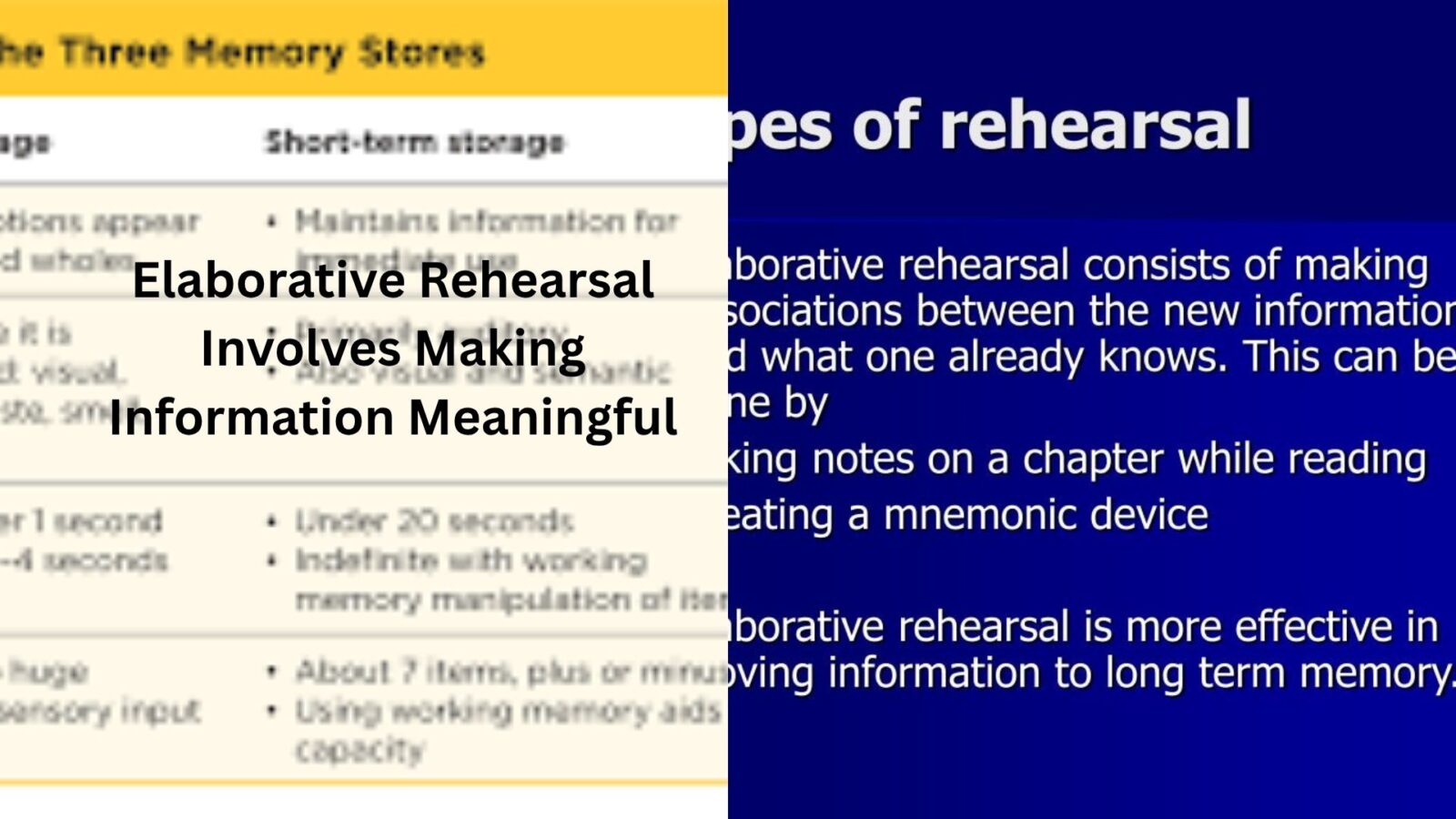
Elaborative rehearsal involves connecting new information to something meaningful so your brain has a reason to keep it. That’s the big idea. Instead of repeating facts over and over like a machine, you actively tie them to memories, emotions, experiences, images, or ideas you already understand.
And honestly, that changes everything.
People often assume memory is about having a “good brain” or a “bad brain.” But memory works a lot more like building hooks. If information hangs there with nothing attached to it, it slips away fast. When you connect it to something familiar, your mind suddenly treats it as important.
That’s why random facts disappear while embarrassing moments from middle school somehow survive forever.
Why Simple Repetition Usually Fails
Think about how most people study.
They reread notes.
Highlight half the page.
Repeat definitions silently.
Then hope the information sticks.
Sometimes it works for short-term memory. Usually not for long-term understanding.
That kind of studying is called maintenance rehearsal. You repeat information exactly as it is without adding meaning to it. It’s useful in small situations. Remembering a temporary password for five minutes? Fine. Keeping a hotel room number in your head? Sure.
But if you want information to stay with you for days, months, or years, repetition alone is shaky ground.
Here’s a simple example.
Imagine someone tells you this random number:
You could repeat it six times and maybe remember it briefly.
Now imagine you connect it to something personal:
48 was your dad’s football jersey number.
29 is your birthday.
71 reminds you of your grandfather’s old pickup truck.
Suddenly the number becomes easier to recall because your brain attached meaning to it.
That’s elaborative rehearsal in action.
Your Brain Likes Connections More Than Raw Data
The brain isn’t really designed to store isolated information forever.
It prefers patterns.
Stories.
Relationships.
Emotion.
Meaning.
That’s why you can remember song lyrics from ten years ago but struggle to remember a grocery list from yesterday.
The lyrics probably carried emotion, repetition, rhythm, and personal memories. The grocery list? Just floating information.
Elaborative rehearsal works because it gives information context.
And context matters more than people realize.
A student memorizing biology terms might struggle if they only repeat definitions. But when they connect those concepts to real-world examples, visual images, or experiences, retention improves fast.
For example, remembering that mitochondria produce energy becomes easier when you picture them as tiny power plants inside cells.
It sounds simple because it is simple.
That’s part of the beauty of it.
Real Learning Feels More Personal
Here’s something interesting.
People remember information better when it relates to themselves.
Psychologists sometimes call this the self-reference effect. But outside of textbooks, it just means your brain pays attention to things that feel personally relevant.
Let’s say you’re learning about negotiation techniques.
If you only memorize terms, your interest fades quickly.
But if you connect the ideas to a recent salary discussion, an argument with a sibling, or even buying a used car, the information suddenly becomes real.
Now your brain has emotional weight attached to it.
That emotional layer makes recall easier.
You’ve probably experienced this naturally without noticing.
Someone tells you a story about traveling in Italy. You forget most details.
Then they mention a tiny coffee shop in Rome that reminds you of a café you visited years ago.
That specific detail sticks.
The memory found an anchor.
Elaborative Rehearsal Isn’t Just for School
A lot of people hear memory techniques and immediately think about classrooms.
But elaborative rehearsal shows up everywhere.
At work.
In conversations.
During training.
Even in relationships.
A manager learning employees’ names might connect each person to a visual feature, personality trait, or shared interaction.
A doctor may remember symptoms by linking them to patient stories.
A chef remembers recipes by understanding flavor relationships rather than memorizing measurements blindly.
Good teachers do this naturally too.
The best teachers rarely dump raw information on students. They tell stories. Use analogies. Build mental pictures.
That’s not accidental.
They understand people remember meaning better than isolated facts.
Honestly, this is why some lectures disappear from memory before lunch while others stay vivid years later.
The Difference Between Memorizing and Understanding
Now here’s where things get important.
Elaborative rehearsal doesn’t just help memory.
It improves understanding.
That’s a major difference.
Someone can memorize a formula mechanically and still have no clue how to apply it.
You see this all the time in school. Students ace a quiz and then completely freeze when faced with a slightly different problem.
Why?
Because the information never became flexible knowledge.
It stayed trapped as surface-level memorization.
Elaborative rehearsal forces deeper thinking.
You ask questions.
How does this connect to something I already know?
Why does this matter?
What’s a real example?
What would happen if this changed?
That deeper processing creates stronger memory pathways.
And strangely enough, it often makes learning feel less exhausting.
Cramming through brute repetition drains people mentally. Connecting ideas feels more natural because the brain enjoys meaning.
Small Everyday Examples Matter More Than Fancy Techniques
Some memory advice online gets weird fast.
People start building giant imaginary palaces in their heads or turning grocery lists into dramatic adventure stories.
Those methods can work, but most people don’t need anything extreme.
Simple connections already go a long way.
If you meet someone named Rose, you picture an actual rose.
If you’re learning a historical date, you connect it to another event you already know.
Trying to remember a task? Link it to a routine.
Put the reusable grocery bags near your car keys.
Tie the dentist appointment mentally to your morning coffee.
Tiny associations help memory because they create retrieval cues.
That’s the practical side of elaborative rehearsal people often overlook.
It’s not only about studying harder.
It’s about building smarter mental links.
Why Stories Stick So Well
Humans are story-driven creatures.
Always have been.
Give someone ten disconnected facts and they’ll forget most of them.
Wrap those same facts inside a story and recall improves dramatically.
That’s elaborative rehearsal working beneath the surface.
Stories naturally organize information into cause and effect.
They create emotion.
Movement.
Conflict.
Images.
The brain loves that structure.
This explains why people can remember entire movie plots yet forget a three-item work instruction.
The movie created emotional and narrative connections.
The instruction list didn’t.
Good communicators understand this instinctively.
A business leader explaining company values through a personal experience will usually be remembered more than someone reading bullet points from a slide.
Even parents do this.
Kids rarely remember long lectures about honesty.
They remember the story about the time mom lied as a child and got caught.
Stories create mental glue.
Sleep, Emotion, and Attention Still Matter
Elaborative rehearsal is powerful, but it’s not magic.
If someone is exhausted, distracted, or emotionally overloaded, memory struggles anyway.
Attention matters first.
You can’t meaningfully connect information you barely noticed.
Sleep matters too.
A tired brain stores memories poorly. Most people know this from experience, especially after trying to study at 2 a.m. while staring blankly at the same paragraph.
Emotion also changes retention.
Strong emotional experiences naturally become easier to remember because the brain treats them as significant.
That’s why people vividly remember stressful moments, exciting news, or deeply embarrassing situations.
Emotion intensifies encoding.
Elaborative rehearsal works partly because meaningful connections often trigger emotion, curiosity, or interest.
And once those enter the picture, memory becomes stronger.
Technology Changed How We Remember
Here’s something worth thinking about.
People rely on external memory more than ever.
Phone reminders.
Cloud notes.
Search engines.
Saved passwords.
That convenience helps, obviously. Nobody wants to memorize fifty login credentials.
But there’s a downside.
Sometimes we stop engaging deeply with information because we assume we can retrieve it later.
You see this during meetings all the time.
Someone says, “I’ll just check the notes later,” and mentally disengages.
The information never gets processed deeply enough to become memorable.
Elaborative rehearsal pushes against that habit.
It asks the brain to participate instead of passively storing information somewhere else.
And frankly, that active engagement often leads to better thinking overall.
People who connect ideas deeply tend to explain concepts more clearly, solve problems faster, and adapt knowledge more flexibly.
How to Use Elaborative Rehearsal Naturally
The good news is you probably already use this technique sometimes.
Most people do.
The trick is using it intentionally.
When learning something new, pause for a second and ask:
What does this remind me of?
Where have I seen this before?
Can I explain this in my own words?
Could I teach it to someone else?
That last one works especially well.
Teaching forces elaboration because you must organize information meaningfully instead of simply repeating it.
Another useful habit is visualization.
The brain remembers vivid images surprisingly well.
If you’re learning about supply chains, imagine trucks moving products across cities.
Learning anatomy? Picture the body systems interacting physically.
Learning a language? Associate new vocabulary with scenes, sounds, or personal experiences.
It doesn’t have to be perfect.
Even weak connections help more than pure repetition.
The Biggest Mistake People Make With Learning
A lot of people confuse familiarity with mastery.
That’s the trap.
Rereading notes creates a feeling of recognition. The material looks familiar, so the brain assumes it’s learned.
But recognition is not the same as recall.
Real learning happens when you can retrieve information independently and connect it flexibly.
Elaborative rehearsal supports that process because it strengthens retrieval pathways.
Instead of storing information in a fragile isolated form, the brain builds multiple access points.
One idea links to another.
Then another.
That network makes recall easier later.
It’s similar to walking through a city.
If there’s only one road to your destination, getting lost is easy.
If multiple roads connect there, navigation becomes simpler.
Memory works in a surprisingly similar way.
Why This Approach Feels More Human
At its core, elaborative rehearsal involves making information part of a larger personal picture.
That’s why it works so well.
Humans naturally learn through relationships and meaning.
Not through robotic repetition.
We remember conversations tied to emotion.
Lessons tied to stories.
Facts tied to experience.
The information becomes woven into something bigger than itself.
And honestly, that’s probably why the best learning experiences stay with us long after details fade.
Not because we memorized every word.
Because something connected.
That connection is where memory becomes real.